Coastal facts · tides · salinity
Baltic or North Sea?
Baltic or North Sea – the two German coasts compared directly. Travemünde lies on the Baltic Sea, in the Lübeck Bay. This overview shows where they differ in tides, salinity, depth and bathing.
Baltic or North Sea – the quick overview
The Baltic Sea is an almost fully landlocked inland sea. It connects to the North Sea and the Atlantic only through the Danish straits – the Little and Great Belt and the Øresund. The North Sea, by contrast, is an open marginal sea of the Atlantic, wide open to the ocean. Almost every other difference follows from this one: tides, salinity and waves.
Tides
On the North Sea, the tides shape the day: the tidal range is 2 to 3.5 metres, and twice a day the sea retreats far across the Wadden Sea. On the Baltic almost none of this is felt – the tidal range is only about 15 centimetres. Here the water level is driven more by wind than by tides.
Salinity
The North Sea carries the full salinity of the Atlantic: about 35 grams of salt per litre. The Baltic is much less salty, because many rivers add fresh water and the exchange with the ocean is limited. Off Schleswig-Holstein the salinity is around 15 to 18 grams per litre and drops further east – experts call it brackish water. Baltic water therefore tastes noticeably less salty.
Depth and coastal forms
The North Sea is on average a good 90 metres deep, the Baltic shallower at about 55 metres. The coasts look different too: the Baltic coast in Schleswig-Holstein is shaped by firths, bodden lagoons and steep cliffs – the Brodten cliff near Travemünde is an example of an active cliff. The North Sea coast is flat and defined by sand, mudflats and marshland.
Climate and bathing
For bathers, character matters most: the Baltic is gentler, the waves usually calm, the flat beaches family-friendly. The North Sea is rougher and windier, with stronger surf and wide mudflats – ideal for water sports such as surfing or kiting. Both have their appeal, just a different one.
And Travemünde?
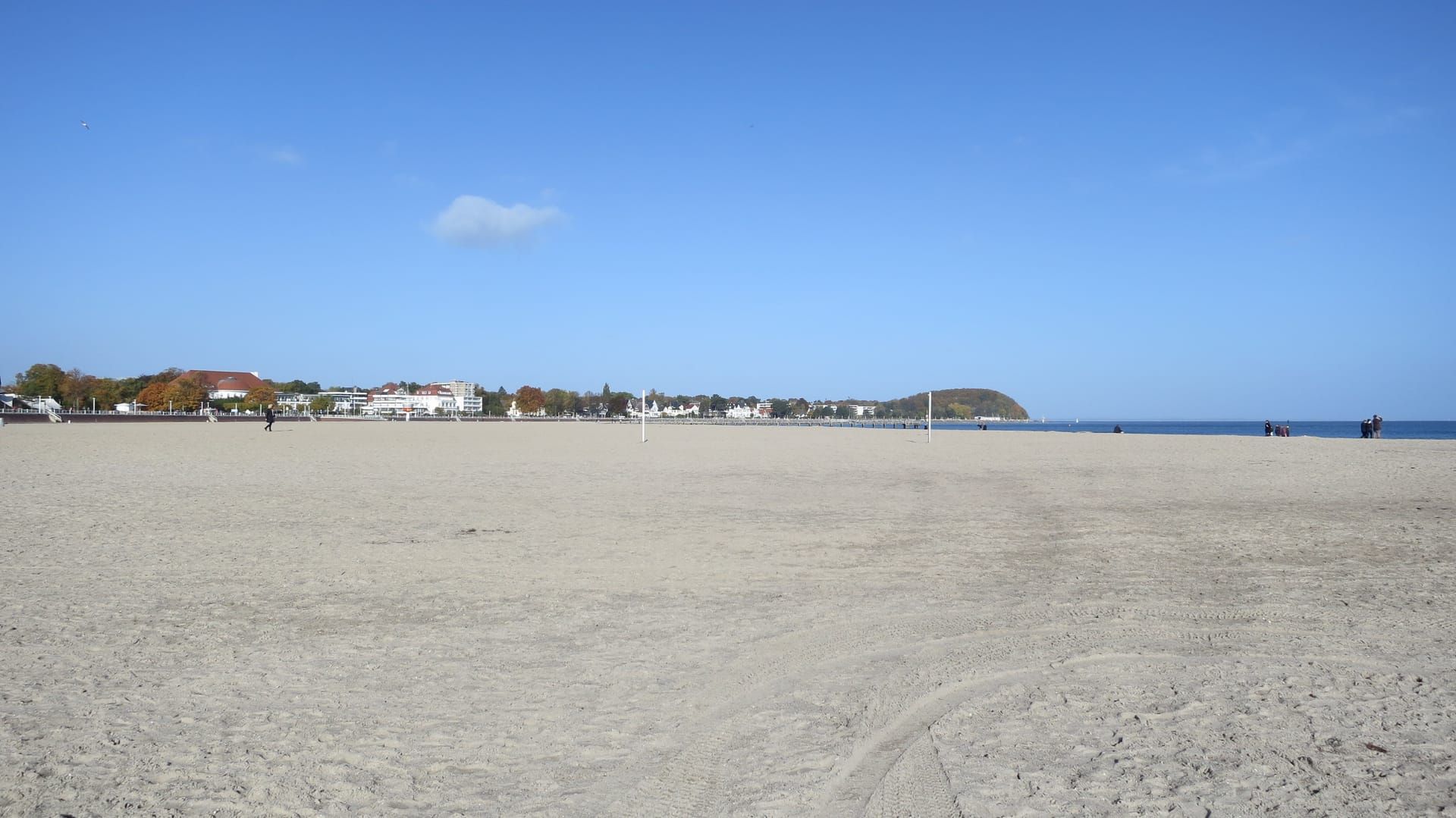
Travemünde lies on the western Baltic, in the Lübeck Bay – calm water, a fine sandy beach and gentle waves rather than heavy surf. For beach sections and water quality see Beach and water, and for current readings see Water temperature.
Frequently asked questions about the Baltic and North Sea
Is Travemünde on the Baltic or the North Sea?
Travemünde lies on the Baltic Sea, in the Lübeck Bay at the western edge of the sea. The North Sea only begins beyond Schleswig-Holstein on the west coast.
Which is saltier, the Baltic or the North Sea?
The North Sea is much saltier at around 35 grams of salt per litre. Off Schleswig-Holstein the Baltic reaches only about 15 to 18 grams and becomes less salty further east (brackish water).
Are there tides on the Baltic Sea?
Barely. The Baltic tidal range is about 15 centimetres and is not noticeable day to day. The North Sea, by contrast, has a tidal range of 2 to 3.5 metres with its famous Wadden Sea.
Why is the Baltic calmer than the North Sea?
The Baltic is an almost landlocked inland sea with a small tidal range and usually gentler waves. The North Sea is an open marginal sea of the Atlantic and therefore rougher and windier.
Where is the water warmer?
In summer the shallower Baltic often warms up faster along the coast than the deeper North Sea. Exact figures depend on the day, the wind and the location.