Windjammer · barque · the Passat
Four-masted barque
“Four-masted barque”, “windjammer”, “barque” – and at the heart of it the Passat, the landmark of Travemünde. What the terms mean and what makes this ship special.
What is a barque?
A barque is a sailing ship with at least three masts. On the forward masts it carries square sails – the rectangular sails set across the ship. On the aftermost mast, by contrast, it carries only fore-and-aft sails, set lengthways along the ship. This combination is what defines a barque and sets it apart from a full-rigged ship.
And a four-masted barque?
A four-masted barque is simply a barque with four masts. Larger barques are named after the number of their masts: the four-masted barque has four, the five-masted barque five. The more masts, the more sail area – and the more power from the wind for these large cargo sailers.
What is a windjammer?
“Windjammer” is the collective term for the large cargo sailing ships of the 19th and early 20th centuries. Under sail these ships carried bulk goods across the oceans, at a time when steamships were slowly replacing them. The Passat, too, is one of these windjammers.
The Passat: a Flying P-Liner
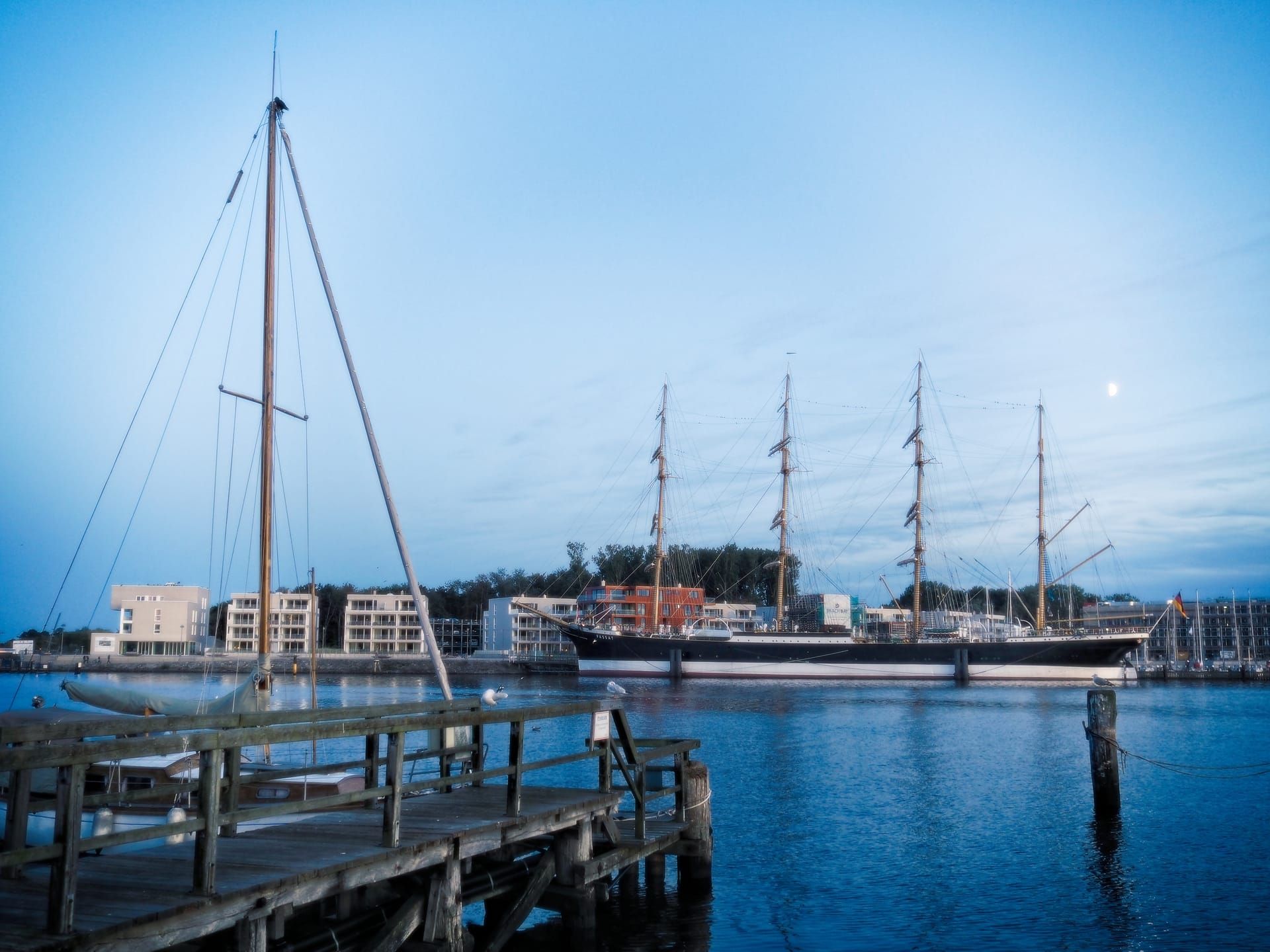
The Passat was built in 1911 by Blohm und Voss in Hamburg for the shipping company F. Laeisz – together with her sister ship, the Peking. She is one of the “Eight Sisters”, the last eight four-masted barques of the Laeisz fleet, whose ship names all began with “P”. Her steel hull is around 115 metres long and 14.3 metres wide. On the saltpetre run she sailed around Cape Horn to Chile.
A museum ship in Travemünde
In 1959 Lübeck saved the Passat from being scrapped. Since her last major refit in 1998 she has been moored as a museum ship at the Priwall in Travemünde, open to visitors. More on the ships of the Trave estuary under Ships and on the landmark on the shore under the Maritim.
Frequently asked questions about the four-masted barque
What is a four-masted barque?
A four-masted barque is a sailing ship with four masts in the rig of a barque: square sails on the forward masts (across the ship) and only fore-and-aft sails on the aftermost mast (lengthways). One example is the Passat in Travemünde.
What is the difference between a barque and a full-rigged ship?
On a full-rigged ship all masts carry square sails. On a barque, by contrast, the aftermost mast carries only fore-and-aft sails while the forward masts carry square sails. It is this last mast that tells the two rigs apart.
What is a windjammer?
“Windjammer” is the collective term for the large cargo sailing ships of the 19th and early 20th centuries, which carried bulk goods across the oceans under sail. The Passat is one such windjammer.
Where is the Passat moored?
The Passat is moored as a museum ship at the Priwall in Travemünde, at the mouth of the Trave where it meets the Baltic Sea. She is open to visitors there.
How old is the Passat?
The Passat was built in 1911 by Blohm und Voss in Hamburg for the shipping company F. Laeisz. She is one of the last eight four-masted barques of the Laeisz fleet, the “Eight Sisters”.